Your refrigerator is running, but the food inside is getting warmer.
Before you pull the appliance away from the wall, start ordering parts, or assume the compressor has failed, check what is still cold.
A refrigerator compartment that is warm while the freezer is still cold is not the same problem as a refrigerator and freezer that are both warm. A unit that stopped cooling right after installation or a power interruption belongs to another path. And a refrigerator that is cold near the vents but warm elsewhere points you toward airflow before major hardware.
The fastest way to narrow this problem is to compare the refrigerator section, the freezer, the doors, and the airflow before doing anything more invasive.
Refrigerator Not Cooling: Quick Answer
Start with what is still cold.
Refrigerator warm, freezer still cold
→ Focus on airflow between the freezer and refrigerator section, blocked vents, food placement, and model-specific air controls before assuming the entire cooling system has failed.
Both refrigerator and freezer are warm
→ Check whether cooling is actually turned on, whether the appliance has stable power, whether it is in Demo or Showroom mode, and whether this started after installation or a power interruption.
Refrigerator is cool, just not cold enough
→ Check temperature settings, doors, airflow, recently added food, room conditions, and installation clearance.
Temperature rises mainly after the door has been open
→ Door sealing, frequent opening, and warm food loads become more relevant.
Heavy frost or ice appears around freezer vents
→ Airflow may be restricted. Do not chip ice away with tools or open electrical or refrigeration components.
The appliance repeatedly clicks, stops cooling completely, or never recovers after the basic checks
→ Move toward model-specific diagnostics or professional service rather than replacing parts by guesswork.
What is still cold usually tells you more than the words “refrigerator not cooling.”
In This Guide
Start Here: What Is Still Cold?
| What you observe | What that changes | Skip for now | Go to |
|---|---|---|---|
| Fridge warm, freezer cold | Cooling exists somewhere | Assuming total cooling failure | Path A |
| Fridge and freezer both warm | Whole-appliance problem | Fridge-only airflow fixes | Path B |
| Some areas cold, others warm | Air distribution matters | Major parts replacement | Path C |
| Started after install or power interruption | Recovery or setup may explain it | Immediate repair call | Path D |
| Door does not seal normally | Warm-air entry is relevant | Internal component guessing | Path E |
| Frost or ice blocks vents | Airflow may be restricted | Forcing or chipping ice | Path F |
Do not follow every path.
Use a refrigerator thermometer if you have one, identify whether the freezer is still holding temperature, and follow the branch that matches the appliance now.
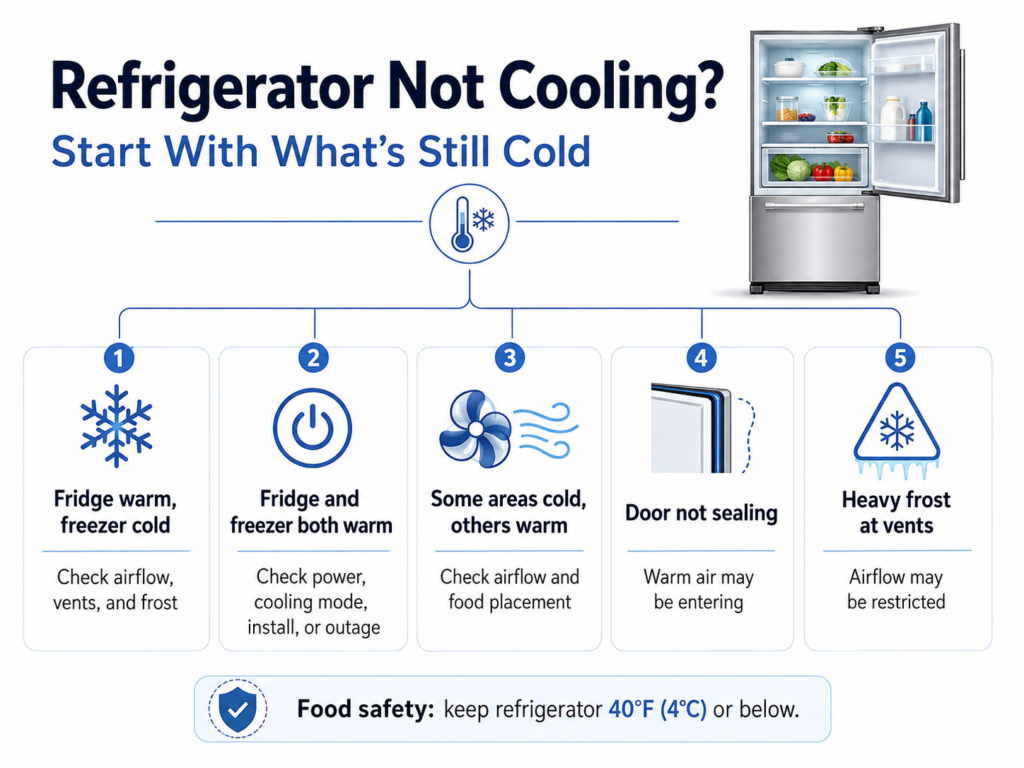
Food Safety Comes First
Do not spend hours troubleshooting while perishable food keeps warming.
Keep the refrigerator at 40°F (4°C) or below. If you are not sure of the actual temperature, use an appliance thermometer rather than judging by touch.
Move important perishables to another working refrigerator or a properly chilled cooler if necessary.
Do not judge food safety only by smell or appearance.
Path A: The Refrigerator Is Warm but the Freezer Is Still Cold
This is one of the most useful patterns.
If the freezer is still clearly cold but the fresh-food section is warming, you already know the appliance has not completely lost all cooling.
Start with airflow.
Check the Air Vents
Look inside the refrigerator and freezer compartments for visible air vents.
Make sure food containers, bags, or large packages are not pressed directly against them.
Do not pack food tightly against the rear or side walls.
Blocked supply or return vents can interrupt chilled-air circulation and create warm areas in the refrigerator compartment.
If rearranging food restores normal cooling after the refrigerator has had time to stabilize, stop there.
Compare Airflow Without Taking Anything Apart
With the refrigerator running, check whether you can notice cool airflow from the accessible interior vents.
Do not remove interior panels, reach into fan assemblies, or bypass door switches.
If the freezer remains cold but airflow into the refrigerator section appears persistently absent, the problem has moved beyond simple food placement.
At that point, model-specific service information is more useful than random part replacement.
Path B: Both the Refrigerator and Freezer Are Warm
If both compartments are warm, stop focusing only on airflow into the refrigerator section.
First verify the basics that affect the entire appliance.
Confirm Cooling Is Turned On
Some refrigerators can have lights and a working display while the actual cooling function is off.
Check the control panel and the manual for your exact model.
Look for indicators such as:
- Demo
- Showroom
- Cooling Off
- OF OF
The wording varies by manufacturer.
Do not copy a button combination from a different refrigerator model.
Confirm the Appliance Has Stable Power
If both compartments are completely warm and the refrigerator does not appear to be operating normally, verify that it is plugged in and that the outlet has power.
Do not remove electrical panels or test internal wiring.
If a breaker repeatedly trips or the outlet or cord shows damage or unusual heat, stop troubleshooting and have the electrical problem checked.
Check the Installation Environment
A refrigerator can struggle when the surrounding temperature is outside the range the model was designed for.
This matters especially for refrigerators installed in garages, enclosed rooms, or very hot spaces.
Check the owner’s manual for the permitted ambient-temperature range for the exact model.
Do not assume every household refrigerator is designed for every garage temperature.
Path C: Some Areas Are Cold but Others Are Warm
If drinks near one shelf are cold while food elsewhere is noticeably warmer, do not immediately turn the thermostat to its coldest setting.
Uneven cooling makes air circulation and loading more useful clues.
Check whether:
- large containers block vents
- shelves are packed tightly
- food is pushed against the back wall
- the door has been opened frequently
- a large amount of warm food was recently added
Air has to circulate through the cabinet.
Give the appliance time to stabilize after rearranging food or adding a large warm load before making repeated temperature adjustments.
Path D: It Started After Installation, a Power Interruption, or a Large Food Load
Timing matters here too.
A refrigerator that was installed a few hours ago should not be diagnosed the same way as one that cooled normally for years and suddenly became warm.
A newly installed refrigerator may need significant time to reach its normal temperature.
If there was a recent power interruption:
- Confirm cooling is turned back on.
- Keep the doors closed as much as possible.
- Measure the actual temperature instead of guessing by touch.
- Allow appropriate recovery time.
A large load of room-temperature groceries can also temporarily raise cabinet temperature.
If the refrigerator never begins recovering after normal power and settings are restored, move to the broader cooling or service path.
Path E: The Door Is Not Sealing Normally
A refrigerator cannot maintain temperature efficiently if warm room air continually enters the cabinet.
Look for simple external causes:
- a food container preventing the door from closing
- a drawer or shelf sticking out
- packaging trapped against the door
- a visibly dirty or folded gasket
- a refrigerator that was recently moved and no longer sits correctly
Clean accessible gasket surfaces according to the manufacturer’s instructions.
Do not start adjusting hinges or disassembling the door unless your model’s manual specifically provides a safe procedure.
If the door consistently will not seal after visible obstructions are removed, the door or gasket deserves more attention than the compressor.
Path F: Frost or Ice Is Blocking Airflow
Heavy frost around vents changes the troubleshooting path.
If cold air cannot move through the intended passages, the fresh-food compartment can become warm even while part of the freezer remains cold.
Do not attack the ice with a knife, screwdriver, heat gun, hair dryer, or another improvised tool.
Do not remove electrical or evaporator covers.
Instead:
- keep food away from blocked vents
- check whether the doors are closing completely
- look for obvious gasket problems
- follow the manufacturer’s model-specific defrost guidance if one exists
Persistent heavy frost can involve a defrost or airflow problem that requires service.
The important point is that frost is evidence. Do not destroy the evidence before you know why it formed.
What You Can Skip Once You Know the Pattern
| If you already know this | Stop spending time on | Focus on |
|---|---|---|
| Freezer cold, fridge warm | Whole-system failure guesses | Airflow and vents |
| Both sections warm | Fridge-only vent fixes | Power, controls, whole cooling path |
| Cooling problem started recently | Immediate part replacement | Setup and stabilization |
| Door visibly will not seal | Compressor guessing | Door obstruction and seal |
| Heavy frost blocks vents | Lowering thermostat repeatedly | Airflow and defrost path |
| Unit remains warm after safe basic checks | Random DIY part swaps | Model diagnostics or service |
What About the Condenser Coils?
This is where generic refrigerator articles often become misleading.
Some refrigerators have owner-accessible condenser areas that the manufacturer tells you to clean. Other models require little routine condenser cleaning, and some areas should only be serviced by a technician.
So the FixWise rule is simple:
Do not pull panels off just because an article says “clean the coils.”
Check the exact owner’s manual first.
If the manufacturer explicitly identifies an externally accessible area that the owner may safely clean, follow those instructions with the appliance powered off as directed.
Otherwise, leave internal service areas alone.
When the Refrigerator Probably Needs Service
Professional service becomes more reasonable when:
- both compartments remain warm after normal settings and recovery time are confirmed
- the freezer stays cold but refrigerator airflow never returns
- heavy frost repeatedly comes back
- the appliance repeatedly clicks or tries to start without restoring cooling
- manufacturer diagnostics report an error
- a door, fan, or internal component appears physically damaged
- there is a burnt smell, sparking, damaged wiring, or unusual electrical heat
- the refrigerator previously cooled normally and suddenly stops with no simple external explanation
Do not attempt sealed-system, refrigerant, compressor, or internal electrical repairs yourself.
Those are no longer simple homeowner troubleshooting steps.
The Fastest Decision
Use this as the short version:
Fridge warm + freezer cold
→ Airflow path.
Fridge and freezer both warm
→ Whole-appliance power, controls, or cooling path.
Some shelves cold, others warm
→ Air distribution and food placement.
Recently installed or recently lost power
→ Recovery and setup path.
Door will not seal
→ Door and gasket path.
Heavy frost blocks vents
→ Frost and airflow path.
Basic checks make no difference
→ Model diagnostics or professional service.
Common Questions
Why is my refrigerator not cooling but the freezer still works?
On many refrigerator designs, cold air is circulated between compartments.
If the freezer remains cold while the refrigerator warms, airflow becomes a more useful clue than assuming the appliance has completely lost cooling.
Blocked vents, frost, food placement, or another air-distribution problem may be involved.
How cold should a refrigerator be?
Keep the refrigerator at 40°F (4°C) or below and the freezer around 0°F (-18°C).
Use an appliance thermometer if you need to know the actual temperature.
How long should a new refrigerator take to get cold?
Manufacturer guidance varies, but a newly installed refrigerator can require many hours to stabilize and may take roughly a day to reach normal temperatures.
Use the instructions for your exact model.
Should I turn the refrigerator to the coldest setting?
Not automatically.
First check the actual temperature, airflow, door closure, and whether the unit recently experienced a large food load, installation change, or power interruption.
Make temperature changes gradually and allow the refrigerator time to respond.
Does a warm refrigerator mean the compressor is bad?
No.
Temperature settings, airflow, doors, installation conditions, Demo mode, recent food loading, power problems, frost, and other issues can all result in poor cooling.
A warm compartment alone does not identify the compressor as the failed component.