Your dryer runs. The drum turns. The timer moves.
But the clothes stay cold and wet.
That combination matters because a dryer can still tumble even when the heating side of the system is not working normally. On some electric dryers, the motor and heating system rely on different parts of the power supply, so the drum can turn while the dryer produces no heat. Gas dryers can also tumble normally while the heating side is unavailable.
So don’t start by ordering a heating element.
First answer a simpler question:
Is the dryer producing any heat at all?
A dryer with absolutely no heat belongs to a different diagnostic path from one that gets warm but takes two hours to dry a load.
Dryer Not Heating: Quick Answer
The drum turns, but there is absolutely no heat
→ Make sure you are using a heated cycle. Then identify whether the dryer is electric or gas before going farther.
The dryer gets warm, but clothes take forever to dry
→ Stop treating it as a true no-heat problem. Airflow, vent restriction, load size, and moisture removal become more important.
Air Only, Air Fluff, or a no-heat cycle is selected
→ The dryer may be operating exactly as designed. Switch to a heated cycle before diagnosing hardware.
Electric dryer runs but produces no heat
→ A partial electrical-supply problem can allow the motor to run without providing the full power needed for heat. Do not open the dryer or test high-voltage wiring yourself.
Gas dryer runs but produces no heat
→ Gas supply or the internal heating/ignition system becomes more relevant. Do not disassemble gas components or attempt ignition-system repairs yourself.
Dryer smells burnt, sparks, overheats, or shows damaged wiring
→ Stop using it and disconnect power if you can do so safely. Have it inspected before running another cycle.
The first useful question is not “Which part failed?” It is “Does the dryer make any heat at all?”
In This Guide
Start Here: Is the Dryer Making Any Heat?
Use a normal heated timed cycle, not Air Only or Fluff.
Run the empty dryer for a few minutes, then stop the cycle and check whether the inside of the drum has become noticeably warm.
Whirlpool and Maytag use a similar heated-cycle check in their official no-heat troubleshooting before sending users down either the true no-heat path or the drying-performance path.
| What you observe | What that changes | Skip for now | Go to |
|---|---|---|---|
| Drum stays completely cold | True no-heat problem | Long-dry-only fixes | Path A |
| Drum becomes warm | Heating exists | Heating-element guessing | Path B |
| Air Only / Fluff selected | Heat intentionally disabled | Hardware diagnosis | Path C |
| Electric dryer, no heat | Power/heating path | Gas troubleshooting | Path D |
| Gas dryer, no heat | Gas/heating path | Electric 240V troubleshooting | Path E |
| Burning smell, sparks, abnormal heat | Safety issue | Further testing | Stop |
Do not follow every path.
Pick the one that matches what the dryer actually does.
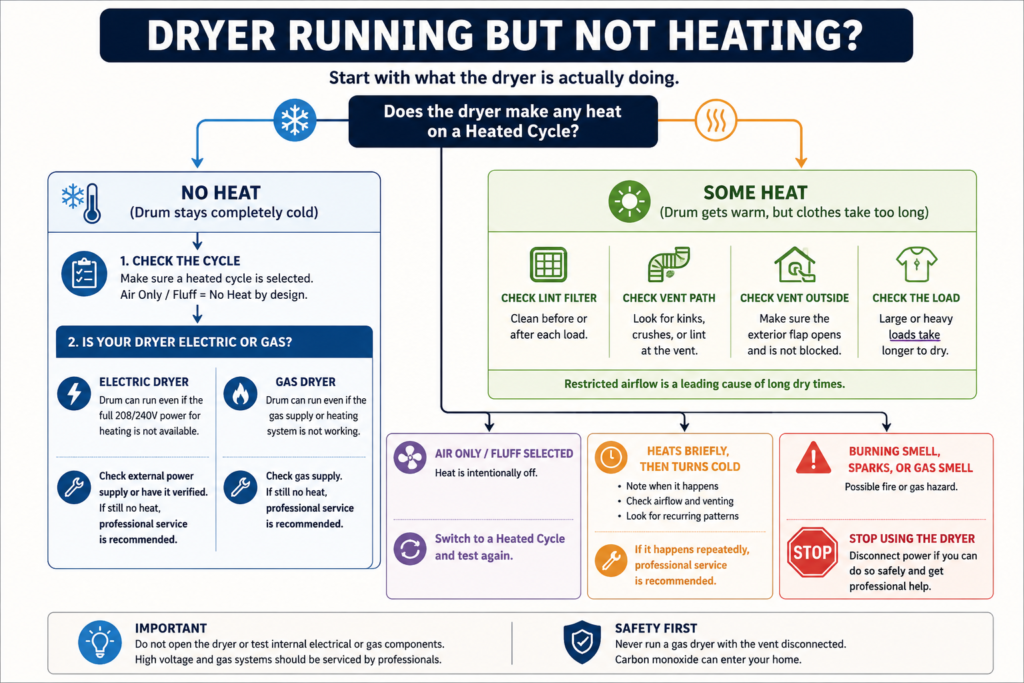
Path A: The Dryer Runs but Produces No Heat at All
If the drum turns normally but remains cold on a heated cycle, you have now separated this from a basic “dryer will not start” problem.
The drive motor is clearly doing something.
The useful questions now are:
- Is the dryer electric or gas?
- Is a heated cycle actually selected?
- Has anything changed recently with the appliance or home power?
- Does the machine display an error code?
- Does the dryer produce even brief heat at the beginning of the cycle?
Do not open the cabinet or start testing internal heater, fuse, wiring, or ignition parts.
Those checks involve electrical or gas systems and are better handled with the exact service information for the model by a qualified technician.
Path B: The Dryer Gets Warm but Clothes Take Too Long to Dry
This is not the same problem as a completely cold dryer.
If the drum becomes warm, the heating system is producing at least some heat.
Now look at airflow and moisture removal.
Maytag says that when a dryer is heating but dry times remain long, restricted venting or airflow becomes a leading path. GE similarly notes that restricted exhaust airflow can increase drying times and cause excess heat and moisture to build inside the dryer.
Check the Lint Filter
Make sure the lint screen is installed correctly and is not heavily covered with lint.
CPSC recommends cleaning the lint filter before or after each use and maintaining the dryer exhaust system because lint and restricted airflow contribute to dryer-fire risk.
Look at the Accessible Vent Path
Without taking the dryer apart, check the visible exhaust hose and outside vent.
Look for:
- a crushed or sharply kinked hose
- lint buildup at the outside vent
- an exterior flap that does not open normally while the dryer is operating
- objects blocking the dryer’s air intake area
CPSC specifically recommends keeping the exhaust vent pipe unrestricted and cleaning lint from the vent pipe periodically.
Do not run a gas dryer with its exhaust disconnected. GE warns that doing so can allow carbon monoxide into the room.
Check the Load
A packed drum can also make drying performance look worse.
Heavy towels, bedding, jeans, and other water-holding fabrics can take much longer than a small mixed load.
If the dryer is clearly producing heat but only certain oversized loads take too long, do not treat that alone as proof of a heating failure.
Path C: Check the Cycle Before You Diagnose the Dryer
This sounds obvious, but it eliminates a real false alarm.
Look for cycle names or settings such as:
- Air Only
- Air Fluff
- Fluff
- No Heat
- Cool
- Rack Dry with no heat
Whirlpool, Maytag, and GE all document cycles or settings that intentionally operate without normal heat.
Select a normal heated timed-dry cycle and test again.
If heat returns, stop troubleshooting.
The dryer was following the selected setting.
Path D: Electric Dryer Runs but Has No Heat
This pattern can be confusing because the machine does not look “dead.”
The drum can still turn.
On many electric dryers, however, heating requires the full 208/240V electrical supply. Whirlpool explains that an electric dryer uses two sides of its power circuit, and one side can power the motor while the heating side is unavailable. GE likewise states that an electric dryer may run on partial voltage but still fail to heat.
That means:
Running does not prove the electrical supply is fully normal.
What You Can Safely Check
Look for obvious external clues:
- Did the no-heat problem begin after a power outage?
- Is another large 240V appliance also behaving strangely?
- Is there a burnt smell around the dryer plug or outlet?
- Is the power cord visibly damaged?
Do not remove electrical covers or test the 208/240V outlet yourself.
If the cycle is correct and the electric dryer remains completely cold, have a qualified adult or electrician verify the dryer circuit and supply.
If the external power supply is confirmed normal, the problem has moved into the dryer’s internal heating or control system and service becomes the safer next step.
Path E: Gas Dryer Runs but Has No Heat
A gas dryer can also tumble without producing heat.
Whirlpool states that a gas dryer drum can turn even if the gas supply needed for heating is unavailable. GE similarly separates gas-dryer no-heat troubleshooting from normal motor operation.
Do not open gas connections, remove burner components, or try to test the ignition system yourself.
Instead, ask:
- Is this a new installation?
- Did the problem begin after gas service or appliance work?
- Is there an error code?
- Is the dryer completely cold on a heated cycle?
If the dryer has a confirmed gas supply but still produces no heat, GE recommends service rather than continued homeowner gas-system troubleshooting.
Stop Immediately if You Smell Gas
Do not keep testing the dryer.
Leave the area and follow your gas utility or local emergency instructions from a safe location.
Do not operate switches, start appliances, or attempt to repair the gas connection yourself.
Path F: It Heats Briefly, Then Turns Cold
This is different from a dryer that never heats at all.
If the dryer gets warm at first but later becomes cold while the drum continues turning, note the pattern rather than restarting it repeatedly.
Ask:
- Does it happen on every heated cycle?
- Does the dryer become unusually hot first?
- Do clothes remain wet despite a long cycle?
- Is airflow at the exterior vent weak?
- Does an error code appear?
Restricted airflow deserves attention because a dryer that cannot exhaust heat and moisture normally can behave very differently from a true no-heat dryer. GE documents restricted venting as a cause of high dryer temperature and longer drying times.
If airflow looks normal and the dryer repeatedly loses heat during the cycle, model-specific service diagnostics are more useful than replacing random thermal fuses, thermostats, or heater parts.
What You Can Skip Once You Know the Pattern
| If you already know this | Stop spending time on | Focus on |
|---|---|---|
| Dryer is completely cold | Long-dry-only advice | True no-heat path |
| Dryer clearly gets warm | Assuming zero heat | Airflow / drying performance |
| Air Only is selected | Parts replacement | Correct heated cycle |
| Electric dryer tumbles but stays cold | Assuming power is fully normal | Electrical supply / service |
| Gas dryer tumbles but stays cold | Electric-dryer troubleshooting | Gas heating path / service |
| Burning smell or sparking | More diagnostic cycles | Stop using dryer |
What About the Dryer Vent?
The vent matters, but not every “dryer not heating” case is a vent problem.
That distinction matters.
If the drum is completely cold from the beginning of a heated cycle, start with the true no-heat path.
If the dryer does produce heat but clothes take too long, the vent becomes much more important.
CPSC recommends maintaining the lint screen and exhaust duct because lint buildup and restricted airflow can contribute to dryer fires. It estimates thousands of residential dryer fires occur in the U.S. each year.
Keep the accessible vent path clear.
Do not dismantle gas, electrical, or internal dryer assemblies in order to “clean everything.”
When the Dryer Probably Needs Service
Professional diagnosis becomes more reasonable when:
- the dryer stays completely cold on a confirmed heated cycle
- an electric dryer still has no heat after its external power supply is professionally confirmed normal
- a gas dryer has no heat with a confirmed supply
- heat appears briefly and repeatedly disappears
- the machine reports a persistent error code
- the dryer overheats despite an unobstructed external vent
- the power cord, outlet, or appliance shows visible heat damage
- you smell burning
- you see sparking
- the dryer has internal electrical or gas-related symptoms
Do not buy a heating element, thermal fuse, thermostat, igniter, gas valve, or control board simply because one of those parts appears in a generic troubleshooting article.
The symptom tells you which system to investigate next.
It does not prove which internal component failed.
The Fastest Decision
Use this as the short version:
Dryer is completely cold
→ True no-heat path.
Dryer gets warm but clothes stay wet
→ Airflow and drying-performance path.
Air Only / Fluff selected
→ Correct the cycle first.
Electric dryer tumbles but stays cold
→ Electrical-supply or internal heating path.
Gas dryer tumbles but stays cold
→ Gas heating path.
Heat starts, then disappears
→ Record the pattern and check airflow before service.
Burning smell, sparks, gas smell, or abnormal heat
→ Stop using the dryer.
Common Questions
Why does my dryer run but not heat?
Because the system that turns the drum and the system that produces heat are not always the same failure point.
An electric dryer can sometimes tumble without receiving the full electrical supply required for heating, while a gas dryer can tumble even when its heating side is unavailable.
Can a tripped breaker make the dryer run but not heat?
On some electric dryers, yes.
Official Whirlpool and GE troubleshooting both explain that partial electrical supply can allow the dryer to run while preventing normal heating. Because this involves a high-voltage dryer circuit, have a qualified adult or electrician handle electrical-panel or voltage testing.
Why is my dryer warm but clothes are still wet?
If the dryer clearly produces heat, airflow and moisture removal become more relevant.
A clogged lint screen, restricted exhaust path, crushed vent, oversized load, or other airflow problem can increase drying time.
Does a dryer not heating mean the heating element is bad?
No.
Wrong cycle selection, incomplete electrical supply, gas-heating issues, airflow problems, and other faults can all produce some version of poor or missing heat.
Do not replace an internal component based on the symptom alone.
Should I keep running the dryer to test it?
Only enough to determine whether a normal heated cycle produces heat.
Stop using the dryer if you notice a burnt smell, sparking, abnormal overheating, damaged wiring, or other signs of an electrical or fire hazard. CPSC specifically warns that overheated dryers and restricted exhaust systems can contribute to fires.
Official Support References
- Whirlpool: Dryer Is Not Heating
- Whirlpool: Not Heating — Electric Dryer
- Whirlpool: Not Heating — Gas Dryer
- GE Appliances: Electric Dryer — Runs but Does Not Heat
- GE Appliances: Gas Dryer — Runs but Does Not Heat
- GE Appliances: Dryer Venting Issues
- U.S. Consumer Product Safety Commission: Clothes Dryer Safety