Your AC is running, but the house is still getting warmer.
Before you assume the system needs refrigerant, a new compressor, or an expensive repair, find out where the cooling process stops.
An AC that barely moves air from the vents is not showing the same problem as one that blows strongly but the air feels warm. And a system that produces cold air but still cannot cool the house belongs to a different path again.
So do not work through a generic list of “10 AC fixes.”
Start with what the system is still doing.
AC Running but Not Cooling: Quick Answer
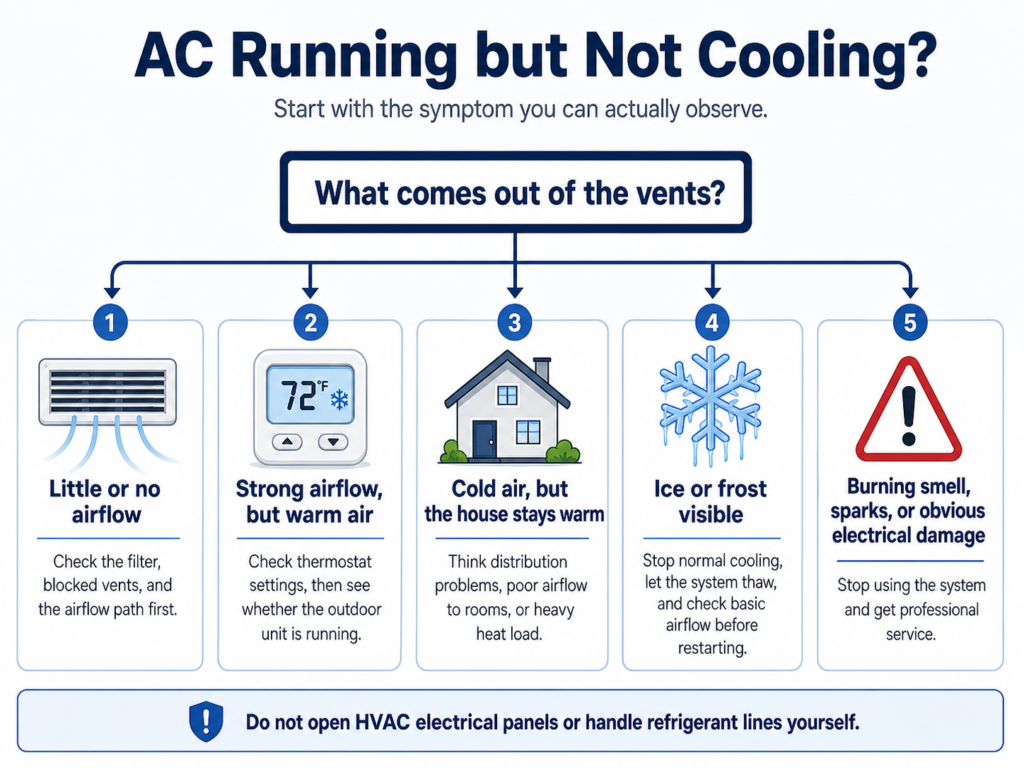
Start at the vents.
Little or no air is coming from the vents
→ Focus on the airflow path first: thermostat fan settings, the accessible air filter, blocked supply/return vents, and whether the indoor system is actually moving air.
Airflow feels normal, but the air is not cold
→ The blower is moving air, but the cooling side is not doing its job normally. Check thermostat settings and visually check whether the outdoor unit appears to be operating. Refrigerant, compressor, or internal electrical diagnosis belongs to a professional.
Cold air comes from the vents, but the house still does not cool
→ The system is producing cooling. Distribution, closed/blocked vents, heavy heat load, duct issues, system sizing, or building conditions become more relevant.
The outdoor unit is not running while indoor air still blows
→ Stop treating this as a simple filter problem. The outdoor cooling stage is not operating normally and may require service.
Ice or heavy frost is visible on refrigerant tubing or the indoor/outdoor cooling equipment
→ Stop normal cooling operation and move to the frozen-system path. Do not chip ice away or open equipment panels.
There is a burnt smell, sparking, damaged wiring, or unusual electrical heat
→ Stop using the system and arrange professional service.
The useful question is not “Why isn’t my AC cold?” It is “How far through the cooling process does the system still get?”
In This Guide
Start Here: What Comes Out of the Vents?
Stand at a normal supply vent while the thermostat is calling for cooling.
Do not open equipment panels.
Compare what you observe with the closest row below.
| What you observe | What that changes | Skip for now | Go to |
|---|---|---|---|
| Little or no airflow | Air movement is the first problem | Refrigerant guessing | Path A |
| Strong airflow, but air feels warm | Blower works; cooling stage needs attention | Duct-only fixes | Path B |
| Air is cold, but house stays warm | Cooling exists | Assuming total AC failure | Path C |
| Outdoor unit appears not to run | Outdoor cooling stage is missing | Repeated thermostat changes | Path D |
| Ice or frost is visible | System may be frozen | Continuing normal cooling | Path E |
| System cools but runs almost constantly | Capacity/load/performance matters | Random part replacement | Path F |
Do not follow every path.
The purpose of this page is to eliminate the branches that do not match what your AC is actually doing.
Path A: Little or No Air Is Coming From the Vents
If the thermostat is calling for cooling but airflow from the supply vents is extremely weak, start with airflow before blaming the refrigerant system.
A dirty filter can restrict airflow and reduce cooling performance. ENERGY STAR recommends inspecting, cleaning, or replacing filters regularly because restricted airflow makes HVAC equipment work harder and can contribute to equipment problems.
Check the Thermostat First
Confirm:
- The thermostat is set to Cool
- The set temperature is below the current indoor temperature
- The fan setting is appropriate for normal cooling operation
If the thermostat is set to Fan On, the indoor blower can circulate air even when active cooling is not occurring.
That can make the system appear to be “running” while the air does not feel cold.
Check the Accessible Air Filter
If your system has a homeowner-accessible filter, inspect it according to the equipment or filter instructions.
If it is visibly dirty and is a replaceable type, replace it with the correct size and type.
If it is reusable, follow the manufacturer’s cleaning instructions.
Do not remove HVAC equipment panels looking for a filter if you do not know where the serviceable filter is located.
Check the Vents and Returns
Look around the house for:
- supply vents covered by furniture or rugs
- closed registers
- return-air grilles blocked by boxes, furniture, or other objects
Opening a blocked airflow path is very different from attempting internal blower or duct repair.
If airflow remains extremely weak after the accessible filter and visible vents are clear, the problem has moved beyond the simple homeowner path.
Path B: Airflow Is Strong, but the Air Is Not Cold
This is an important distinction.
If plenty of air comes from the vents, the indoor blower is clearly moving air.
Now the question becomes whether the system is actually removing heat.
Start with the thermostat again.
Make sure it is set to Cool rather than Fan, Heat, or another mode.
If the settings are correct, visually check the outdoor unit from a safe distance.
Is the Outdoor Unit Operating?
On a typical central split-system AC, the indoor and outdoor portions work together during cooling.
If indoor airflow continues but the outdoor unit does not appear to be operating, the system is not completing the normal cooling process.
Do not open the outdoor cabinet.
Do not touch wiring, electrical components, or the disconnect.
Do not attempt capacitor, contactor, compressor, or voltage testing.
Those are service-level electrical checks.
If the thermostat and basic airflow checks are normal but the outdoor cooling stage will not operate, professional HVAC diagnosis is the appropriate next step.
If the Outdoor Unit Is Running but the Air Is Still Warm
Check whether leaves, grass, storage, or other objects are visibly crowding the outside of the unit.
The outdoor equipment needs unobstructed airflow around it.
You can remove loose debris from the surrounding area without opening the cabinet or reaching inside the equipment.
If the outdoor unit appears to operate normally and airflow is good but the supply air never becomes cool, the cause may be inside the refrigeration, electrical, or mechanical system.
Do not add refrigerant or attempt to diagnose a refrigerant leak yourself.
Carrier specifically treats suspected refrigerant problems and frozen evaporator coils as professional-service issues.
Path C: The Air Is Cold, but the House Still Does Not Cool
This is no longer a true “no cold air” problem.
The system is producing cold air.
Now ask whether that cooling is reaching the house effectively and whether the system can keep up with the heat entering the building.
Check simple conditions first:
- Are important supply vents open and unobstructed?
- Are return grilles blocked?
- Are exterior doors or windows being left open?
- Has the problem appeared only during unusually hot weather?
- Is one area of the house much warmer than the others?
- Does the thermostat eventually reach the set temperature, just very slowly?
A system that produces cold air but cannot lower the indoor temperature can have airflow/distribution problems, duct problems, excessive heat load, or capacity issues.
Carrier and Trane both note that an undersized system can run for long periods without reaching the desired temperature.
Do not assume that means your unit is definitely undersized.
If the system cooled the same house normally in similar weather before and suddenly cannot do so now, that history matters.
A sudden performance change deserves diagnosis before anyone recommends replacing the entire system.
Path D: Indoor Air Blows, but the Outdoor Unit Does Not Run
This symptom deserves its own path.
The indoor blower can operate while the outdoor cooling equipment does not.
That means “I hear the AC running” does not automatically prove the entire air-conditioning system is operating.
Verify the thermostat is actually requesting cooling.
Then stop at observation.
Do not:
- remove the outdoor-unit panel
- touch the disconnect
- test voltage
- handle capacitors
- push contactors
- bypass safety controls
- touch damaged wiring
If the thermostat settings are correct but the outdoor unit repeatedly fails to start while the indoor blower runs, arrange HVAC service.
If you hear buzzing, smell burning, see damaged wiring, or notice other electrical warning signs, stop using the system.
Path E: Ice or Frost Is Visible
Visible ice changes the troubleshooting path immediately.
A frozen cooling system can result from restricted airflow or other HVAC problems, and continuing to demand normal cooling can make the situation worse.
Carrier identifies restricted airflow, refrigerant issues, and other faults as possible reasons for frozen cooling equipment.
What to Do
Stop normal cooling operation.
Check the accessible air filter and visible vents for obvious airflow restriction.
Do not:
- chip ice with a tool
- use a heat gun
- pour hot water over equipment
- remove evaporator-coil panels
- touch refrigerant tubing or internal components
- attempt to add refrigerant
If the system freezes again after the simple airflow issue is corrected, professional diagnosis is warranted.
Repeated freezing is evidence that something still needs attention.
Path F: The AC Runs Almost Constantly but Barely Keeps Up
A system that produces at least some cold air but runs for extremely long periods is different from a system producing no cooling at all.
Ask when this behavior started.
If it only struggles during extreme outdoor temperatures, building heat load and equipment capacity become more relevant.
If it previously cooled the home normally under similar conditions and recently started struggling, look for a change:
- dirty filter
- blocked airflow
- outdoor debris
- ice
- new hot rooms
- doors or windows allowing outdoor air in
- major changes to the building or thermostat use
If the safe external checks do not explain the change, have the system professionally evaluated.
Do not assume low refrigerant just because the AC runs for a long time.
Do not assume the system needs replacement simply because it struggled on one unusually hot afternoon.
What You Can Skip Once You Know the Pattern
| If you already know this | Stop spending time on | Focus on |
|---|---|---|
| Little or no airflow | Refrigerant guesses first | Filter / vents / airflow |
| Strong airflow but warm air | Repeated vent opening | Cooling stage / outdoor unit / service |
| Cold air but warm house | Treating AC as completely dead | Distribution / load / capacity |
| Indoor blower works, outdoor unit does not | Filter-only troubleshooting | Outdoor cooling stage / service |
| Ice is visible | Continuing to run cooling | Airflow / frozen-system diagnosis |
| Cold air exists but runtime is very long | “No heat transfer at all” assumptions | Performance / load / service |
What About the Outdoor Condenser?
The outdoor unit must move heat out of the house.
That requires airflow around the outdoor coil.
Leaves, tall grass, plants, and other debris can interfere with airflow if they crowd the unit. ENERGY STAR recommends keeping indoor and outdoor HVAC equipment clean and clear of debris, while Carrier lists a blocked outdoor condenser as a common reason for poor cooling.
The FixWise rule is:
Clear the space around the equipment. Do not turn outdoor-unit maintenance into an electrical repair.
Do not remove panels or reach inside the cabinet.
If the equipment itself needs internal cleaning or electrical/mechanical inspection, have it serviced properly.
What About Refrigerant?
Do not treat refrigerant like fuel that an AC simply “uses up.”
If the refrigerant circuit is not operating correctly, a qualified HVAC technician needs to determine why.
Symptoms such as warm supply air, long runtimes, or ice can occur with refrigerant problems, but none of them prove a refrigerant leak by themselves.
Carrier explicitly recommends professional diagnosis for suspected refrigerant issues.
Do not:
- buy refrigerant based only on symptoms
- connect gauges
- open refrigerant lines
- attempt leak repair
- assume “low Freon” is the answer before the system is diagnosed
When the AC Probably Needs Service
Professional HVAC diagnosis becomes the better next step when:
- airflow remains very weak after an accessible dirty filter or blocked vent is ruled out
- the indoor blower runs but the outdoor unit does not
- airflow is strong but the system never produces cool air
- ice returns after basic airflow problems are corrected
- the system repeatedly stops or starts abnormally
- the AC previously cooled normally but suddenly cannot keep up
- the outdoor equipment makes abnormal noises
- there is a persistent system error code
- refrigerant or internal electrical problems are suspected
- you smell burning
- you see sparking, damaged wiring, or electrical heat
Do not replace a compressor, capacitor, blower motor, control board, refrigerant component, or entire AC system simply because it appears in a generic article.
The symptom tells you which part of the cooling process needs diagnosis next.
It does not prove which internal component failed.
The Fastest Decision
Use this as the short version:
Almost no airflow from vents
→ Airflow path.
Strong airflow but warm air
→ Cooling-stage path.
Cold air but house stays warm
→ Distribution, heat-load, or performance path.
Indoor blower works but outdoor unit does not
→ Outdoor cooling/service path.
Ice or frost visible
→ Stop normal cooling and use the frozen-system path.
AC cools somewhat but runs almost constantly
→ Performance/load/service path.
Burning smell, sparking, or electrical damage
→ Stop using the system and arrange service.
Common Questions
Why is my AC running but not cooling?
“Running” can describe only one part of an HVAC system.
The indoor blower may be moving air even when the outdoor cooling stage is not operating normally. Restricted airflow, incorrect thermostat settings, blocked outdoor airflow, frozen equipment, refrigerant issues, or mechanical/electrical faults can also reduce cooling. Carrier and Trane list these among the common causes of an AC that runs without cooling the house properly.
Why is my AC blowing air but it is not cold?
First confirm that the thermostat is set to Cool and that a normal amount of air is moving.
If airflow is strong but the air stays warm, check visually whether the outdoor cooling equipment appears to operate.
If thermostat, filter, vents, and obvious outdoor obstructions do not explain the problem, the cooling system needs professional diagnosis.
Can a dirty air filter stop an AC from cooling?
A heavily restricted filter can reduce airflow and make the system work harder.
ENERGY STAR recommends regular filter inspection and replacement because dirty filters restrict airflow and can contribute to poor performance and equipment problems.
Should I turn the AC off if I see ice?
Yes—stop normal cooling operation rather than continuing to demand cooling from a frozen system.
Check only simple accessible airflow items such as the filter and visible vents, and do not chip the ice or open the equipment.
If freezing returns, have the system diagnosed.
Does AC not cooling mean it needs refrigerant?
No.
Warm air or poor cooling does not prove that refrigerant is low.
Thermostat settings, airflow, outdoor-unit operation, ice, equipment sizing, and electrical or mechanical problems can produce similar symptoms. Refrigerant diagnosis should be handled by an HVAC professional.
Why is cold air coming out but the house is still hot?
If the supply air is clearly cold, the system is producing at least some cooling.
The useful questions shift toward airflow distribution, blocked vents or returns, building heat load, duct performance, and whether the system has enough capacity to keep up.